Coming soon. 5’4 1/2″ unfish HPH. True Ames bamboo keels, concave deck, clear, satin gloss.


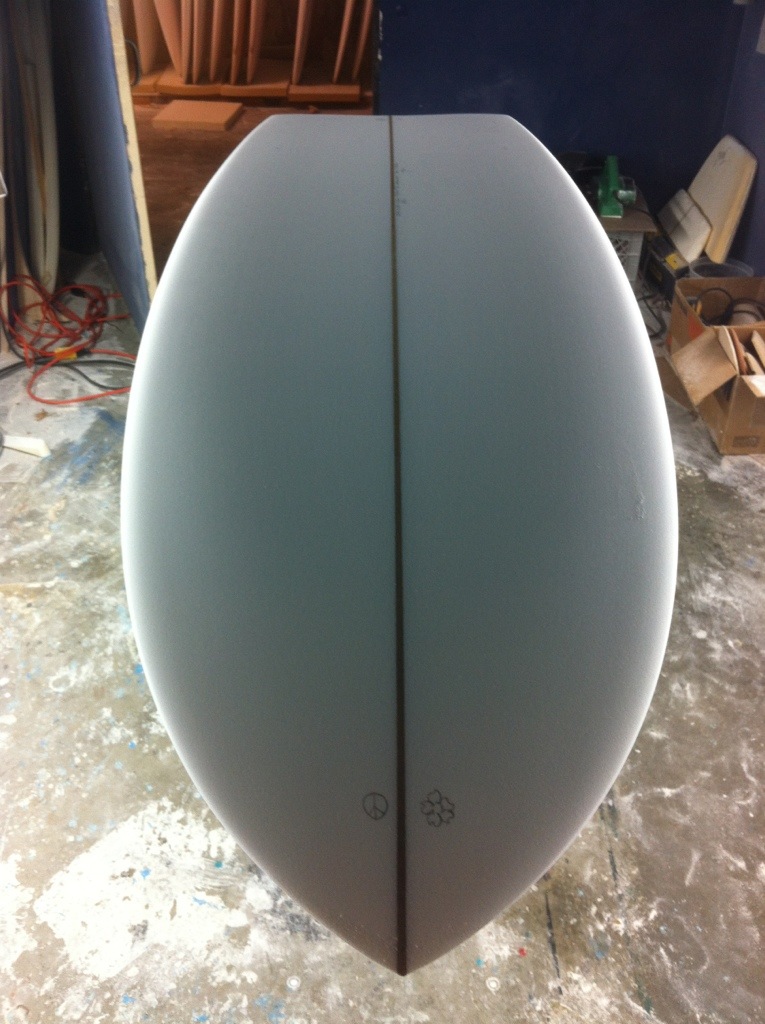
Coming soon. 5’4 1/2″ unfish HPH. True Ames bamboo keels, concave deck, clear, satin gloss.
Coming to Surfindian:
7’2″HPH speedster: (mid-Simmons), 6oz volan, wooden keels
7’7″ hillbilly gentleman: (hull) a milder version of my hillbilly hull in 6 oz volan
7’10″egg: a sleek refined San Diego egg in 6 oz volan

Come on down to Surfindian and check out the fresh new line-up for summer.

Well Surfindian has sold out of my boards again! I just can’t seem to make them quickly enough.
On the way:
9’1″ EDB arc tail, 6oz volan
7’6″ hillbilly hull, 6oz volan
8’6″ Piglet, volan
7’4″ smoothie (hullish egg), 6oz volan
These should be at Surfindian by the beginning of August.
Dropped of two new boards to Surfindian that I’m very exited about. One is a 7’4″ egg in 6oz. volan that should be a great board for the summer. The other is a 7’5 1/2″ hillbilly hull with a cool white resin jailbreak stripe job. Stop down and check them out at Surfindian in beautiful Pacific Beach.
Was able to finally put a face to the name. Met Joaquin from France and his friends at Surfindian today. They purchased a couple of my boards a year or so back and sent a comment that they were enjoying them. It’s always gratifying to realize the happiness that surfing engenders and that I can have a small part in making it happen.

”retro”
It seems any board today between 6’6” and 8’6” gets tagged as retro. While the distinctions are too subtle for the casual observer, any surfer worthy of the title should be able to, upon a quick perusal, distinguish between a true retro shape and most of what is being produced in this size range today.
Admittedly, the outlines for most of the midsize boards I see today are inspired or outright stolen from earlier eras. The similarity usually ends there. Take a look at the obvious things first. Thickness, rails, bottom contour. Unless a shaper is making a conscious effort to match the thick, bulky, flat to vee shapes of the past, there is probably nothing retro about these other elements. Many of today’s ”retro” boards enjoy bottom contours that, with a few notable exceptions, we’re not even dreamt of in the 60’s or 70’s. Rails; the refinement of today’s rail shapes is positively astounding. Have you actually looked at a 70’s era lightning bolt pipeline board? Approaching or even exceeding four inches thick, bulky hard down rails, flat bottom to vee out the tail. Now I’m not trying to put down these shapes. In their day they were the right tool for the job, allowing (or possibly requiring) a style that not only became iconic, but allowed the bold to survive one of the heaviest waves on the planet with panache.
Which brings me to style. The thing about any board, is that is permits, or perhaps even requires, a particular style of surfing. Herein lies the crux of this issue. How do you want to surf. If you feel the need to string together as many moves, lip bashes, and cutbacks on each wave, then the modern shortboard probably is the tool for you. On the other hand, if you spend rainy days watching Morning of the Earth and Litmus, find a board that works for the style of surfing you most admire. If you feel nobody gets you and your style, shape your own boards, or find a sympathetic shaper, until you dial in the required combination of elements that let’s you best express that style. If you love to nose ride, that design thread has been explored for decades. Take your pick. What you are likely to receive from your shaper though, will probably be a much more refined, ”modern” interpretation of the boards used by your style gurus. As you watch closely many of these older films you’ll notice that many of the boards are not working well at all. Occasionally one surfer and board will stand out. These boards often are the hereditary roots of today’s mid size, ”retro” selection, but decades of evolution have rendered them in many cases, much better than the original for the intended style of surfing.
Some people like to waltz. Some people like to slam dance. Choose your dance and then find the tool that allows your most pleasing expression. Today’s variety is as good as it’s ever been. Regardless of what the commercial surf industry is telling you, you can find just about anything, with the possible exception of the next big thing. Although I do believe mid size boards are the next big thing. The good part is that there is no defining set style that determines what you will be riding, no homogenized ”one design” vibe of surf fashion. Fish, Simmons, eggs, bonzers, hulls. You name it. Most are better for the average surfer (that isn’t really married to longboarding) than they realize. As we all get older, and we all will, a bit more volume, a bit more style, and a bit more ease of use will keep us from becoming that angry old shortboarder in the line-up. You know who they (you) are.
So yeah, retro. Anyone who remembers when these types of boards (if they even existed) were cool the first time around, realizes that they were never uncool in interim. They were cool all along. And what makes them cool is that they are the right tool for the job 90% of the time. Longboards? Shortboards? It’s time again for surfboards.
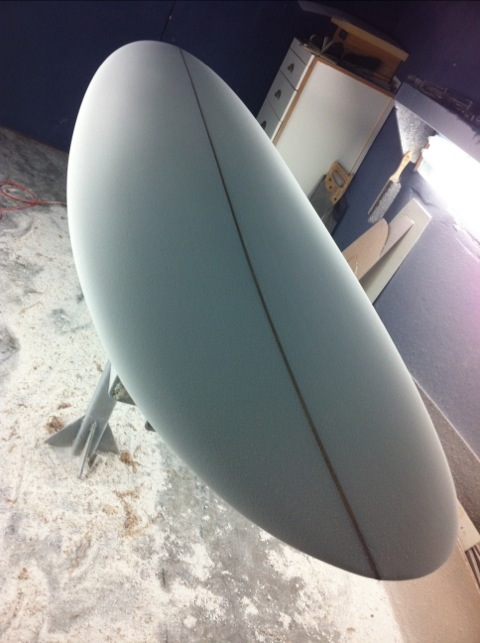

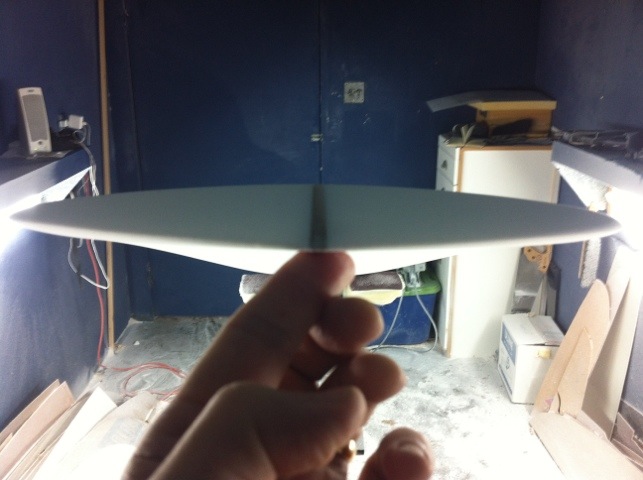
This one is for the Paducah kid, you know who you are (Rich) (not you angry Rich). It’s a hybrid of a full Malibu hull with some concave running out the back for San Diego (as in not perfect point breaks). The rails are as knifey as it gets and it is oh so foiled. Coming soon to Surfindian, unless someone claims it first.
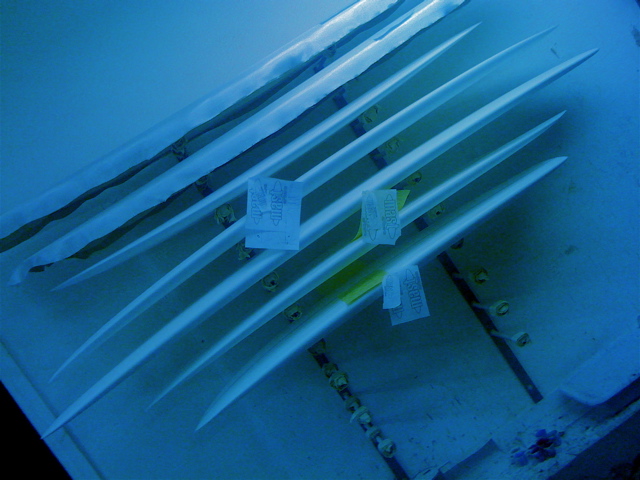
I see a lot of traffic on the net these days looking for hulls. I’m am by no means an expert on surfboard design, but I am an avid student of design and have researched a fair amount. Here is some of what I’ve learned.
Although the recent fascination with hulls has centered around the Greg Liddle “modified transitional displacement hulls”, any surfboard can be considered a hull. There are displacement hulls, planing hulls and as usually is the case, some variant of the two.
As soon as you put an edge at the tail of your board you have created a planing hull. The very nature of the release provided by that edge, by definition puts that board into planing mode. It the edge were left soft and round, you still have a displacement hull. Now whether it is a good one of either type is another matter.
Have you ever seen the old footage of guys towing behind motor boats on their logs? As soon as they get going, the tail end of the board starts submarining and they can literally walk to the nose and go. This demonstrates a the principle of displacement hull theory. A displacement hull has a theoretical hull speed, above which the water actually sucks the hull deeper into the water (I’m simplifying here). Take a sailboat or any other displacement hull and tow it. At anything above the theoretical hull speed, the boat begins to submarine, actually being pulled deeper into the water. Old, soft edged boards are the same, as are any true displacement hulls being produced today. As soon as you put an edge at the tail, you release the water and the board begins to plane. The modern surfboard, most “hulls” included, balance these principles to achieve the desired effect or feel.
Now I’m sure I’ll get some flak for this, but displacement hulls, by their very nature, are not as fast as planing hulls. They may “feel” faster in a section, but without the release, they are constantly dragging more than a sharp edged board would. Now this is not a bad thing. The feeling of a well balance hull is one of the great pleasures of surfing that most people fail to credit. Surfing one well takes a different approach, especially if you are stepping off a thruster. Single fin riders tend to have an easier time.
Another thing I’ll take flak for, and I’m saying it anyway, Greg Liddle did not invent the displacement hull surfboard. He refined it to an amazing degree, made it work in a short package, championing it when it was completely against the trends of the time, but have you ever seen a Weber Foil? Have you ever really looked at almost any board before the mid sixties? All displacement hulls, although arguably not “modified transitional displacement hulls”, whatever that means. Please don’t take this as me dissing Greg Liddle. On the contrary, I think his boards are brilliant and have been a huge design influence for me. It’s just I get a little frustrated when I here people talk about hull this and hull that, without any understanding of what a hull is.
Thanks
Thanks John for the kind words and amazing woodwork. And thank you holly for the lovely photos.
 mast surfboards